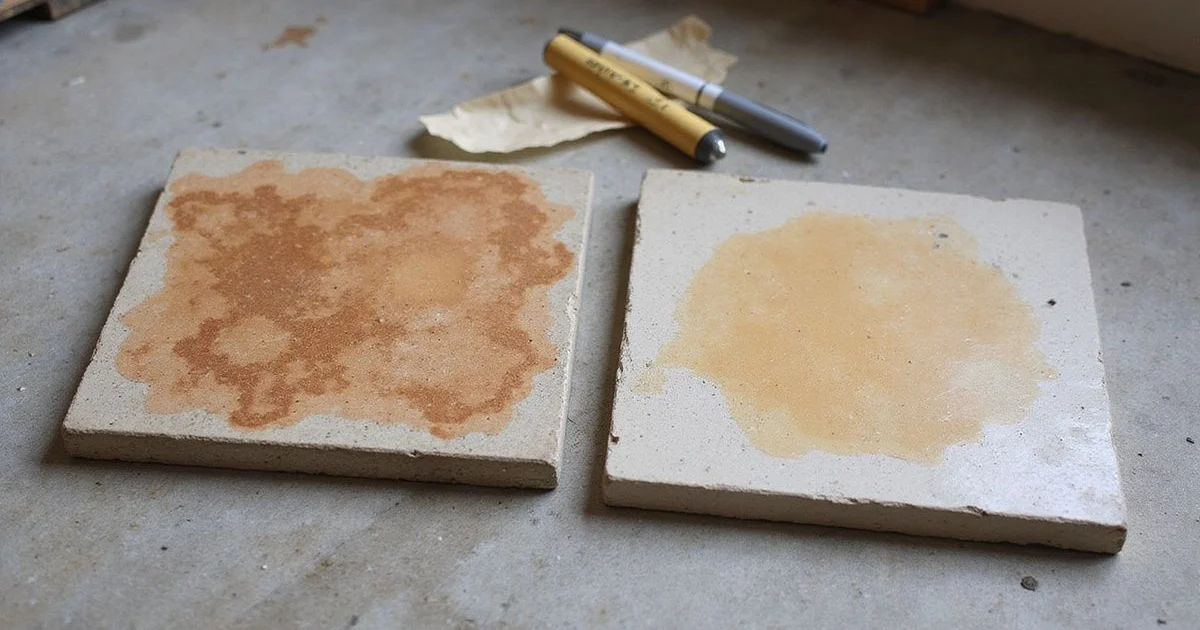
Two Different Chemistries, Two Different Results
This is the distinction that gets blurred most often in sales conversations, and it is worth getting right before you choose a colour for your stained concrete floor.
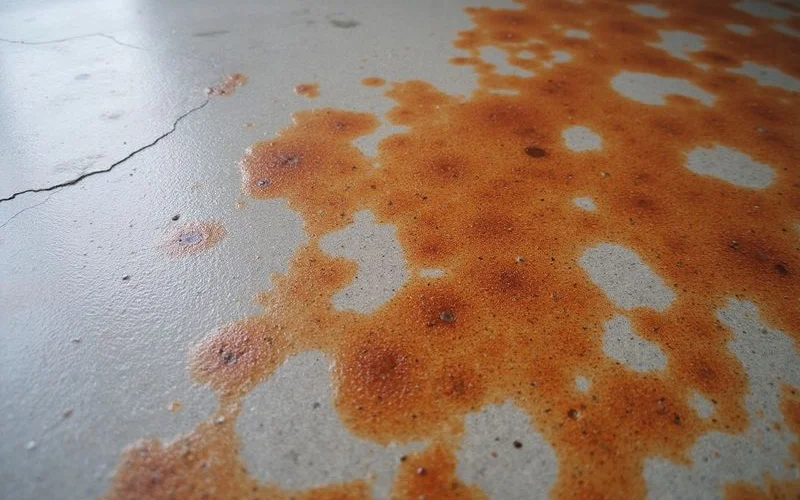
Reactive acid stain is a solution of metallic salts in a mild acid. Applied to concrete, the acid opens the surface and the salts react chemically with lime in the cement paste, depositing colour that becomes part of the concrete. The colour is permanent in the sense that it is not sitting on the surface waiting to wear off. It is also unpredictable, because the reaction depends on your slab’s chemistry.
Water-based stains carry fine pigment in a water or solvent carrier. There is no chemical reaction. The pigment penetrates the surface pores and stays there, protected by the sealer. Colour selection is much wider, results are more consistent, and application technique matters more to the outcome.
Dyes sit at the far end of the same spectrum: very fine particles, strong saturation, high uniformity, and typically used indoors or layered over a reactive base.
Side by Side
| Reactive acid stain | Water-based stain | |
|---|---|---|
| How it colours | Chemical reaction with lime | Pigment in surface pores |
| Palette | Earth tones, greys, limited by chemistry | Wide, including cool and bright tones |
| Variation | High, mottled, cloud-like movement | Lower, still follows slab absorbency |
| Predictability | Depends heavily on the slab | More predictable, still not uniform |
| Application | Requires neutralising and rinsing | Simpler, technique-sensitive |
| Best for | Character, depth, natural movement | Colour control, contemporary tones |
What Each One Needs From Your Slab
Reactive stain needs lime to react with, which means it needs concrete rather than an overlay’s polymer-modified surface, and it needs enough surface porosity for the acid to work. Very tight, power-trowelled slabs react slowly and can come up lighter than expected. Older, more open concrete can react vigorously and come up much deeper.
Water-based products are more tolerant of low porosity and work well on overlays and microtoppings, where reactive chemistry has less to react with. They are the usual answer when the substrate is new, tight, or not traditional concrete.
Both need the same preparation: everything removed, surface profiled, residue gone. Neither will fix an inadequately prepared slab.
The limit that catches people out
Water-based does not mean uniform. It means more consistent. A slab with patches, a filled trench, or areas that were covered for thirty years next to areas that were not will still show that difference under either product. Even colour comes from an even substrate.
Choosing Between Them
Choose reactive acid stain if you want depth, movement, and a floor that reads as natural stone or aged leather; if your slab is genuine concrete with reasonable porosity; and if you are comfortable with a result that is a range rather than a specification.
Choose water-based stain or dye if you need a colour outside the reactive palette, if you want more consistency, if the substrate is an overlay or a very tight new slab, or if you are matching the floor to a specific scheme where control matters more than character.
Consider layering if you want both: reactive movement underneath with a dye adjusting the overall tone. It costs more, takes longer, and produces the most controlled version of a naturally variable floor.
Why We Test Either Way
Whichever product is chosen, a test area on your own slab is the only honest preview. Reactive stain in particular cannot be predicted from a sample board made on someone else’s concrete, because the reaction is with your concrete’s chemistry.
Testing also flushes out problems: residue that survived preparation, patches that behave completely differently, and porosity that changes across a room more than it appeared to.
For the colour decision itself, including how sheen changes what you see, read stained concrete colours and finishes. Then look at test areas in your room’s own light before anybody orders product.