The Short Answer, and What Changes It
Most existing concrete floors can be stained. Whether yours should be stained is a different question, and the answer lives in the slab rather than in the product catalogue.
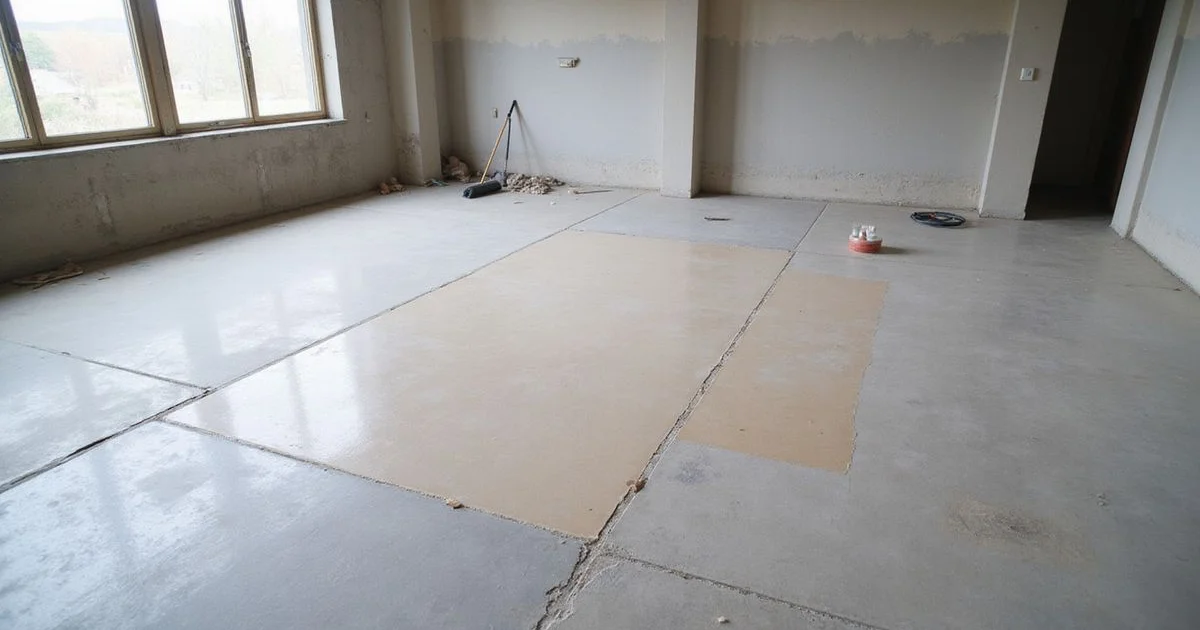
Staining colours the surface of the concrete you already have. It does not add material, it does not level anything, and it does not hide what is underneath. That is exactly why people choose it, and it is also why the condition of your slab decides the result. Before we quote stained concrete floors for any project, we look at four things: what is bonded to the surface, how porous the concrete is, what repairs it already carries, and whether there is moisture moving through it.
What Tile and Carpet Leave Behind
Almost every stained floor project in a lived-in home starts with removing something, and each covering leaves its own signature.
Ceramic tile leaves thinset. Even after the tiles lift, ridges of mortar stay bonded to the slab, and they have to be ground back mechanically. Tile removal also tends to chip the surface where the bond was strongest, so you are usually looking at a slab that needs both profiling and some repair.
Carpet leaves tack-strip holes around the perimeter, staple marks, and adhesive from the underlay. The holes are small and they are permanent unless filled, which means they will read as small dark points in the finished floor if you do nothing about them.
Vinyl and linoleum leave mastic, which is the most stubborn of the three. It is a film that seals the surface completely. Stain cannot penetrate through it, and leftover patches produce a blotchy floor that maps the glue pattern exactly.
Hardwood leaves adhesive or fixing damage depending on how it was laid, and floating floors usually leave the slab in the best condition of any of these.
None of this rules out staining. All of it is work, and all of it belongs in the quote.
The pattern to watch for
Uneven colour on a finished stained floor almost always traces back to uneven preparation. If residue stays in patches, the stain penetrates in patches. That is not a product failure, it is a preparation shortcut.
Porosity, Patches, and Slab History
Once the floor is bare, the next question is how the concrete itself will behave.
Porosity drives colour acceptance. A power-trowelled slab is tight and dense, so it takes colour more slowly and often more lightly. An older, more open floor drinks stain and can come up considerably deeper than the sample suggested. Newer slabs frequently carry a curing compound, invisible to the eye, that blocks penetration entirely until it is removed.
Patches are the other variable, and they are the honest reason we talk about expectations before products. A repair made with a different mix, at a different age, with different aggregate, will never take reactive colour the same way the original pour does. Neither will a filled trench where plumbing was run, or the darker band where a wall used to sit. Reactive stain highlights all of it.
For some people that history is the appeal, and a floor that shows its own past reads as authentic rather than damaged. For others it is a dealbreaker. Knowing which you are before the grinder starts saves a difficult conversation later. Where the slab is too varied for staining to produce a result you will be pleased with, an overlay gives you a fresh, even canvas and colour lands far more predictably on it.
Why Test Areas Settle the Argument
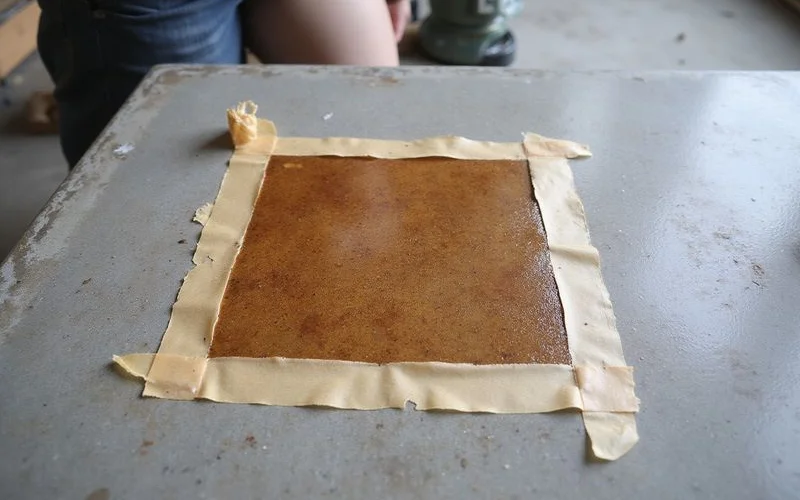
A sample board made on someone else’s concrete tells you what a product can do. A test area on your floor tells you what it will do.
Reactive acid stain works by chemical reaction with the lime in the concrete, so the same product on two different slabs produces two different results. The only way to see your result is to put the product on your slab, in a prepared area, in the room’s own light. We do this wherever colour is in question, and the fifteen minutes it takes has prevented more disappointment than any other step in the process.
Test areas also flush out surprises: residue that survived the first pass of preparation, a patch that reacts completely differently, or porosity that varies across the room more than the surface appearance suggested.
Before You Ask Anyone for a Quote
Pull back a corner of the existing covering if you can do it safely, and photograph what is underneath in daylight. Note any cracking, particularly cracks that run in a consistent direction or that have lipped where one side sits higher than the other. Look for damp patches, white powdery residue, or a musty smell, all of which point to moisture questions that need answering before any sealer goes down.
Then read how stained concrete is prepared and installed, because the preparation stage is where most of the money and nearly all of the quality goes.
If your slab is a candidate, the next conversation is about colour, sealer, and scope. If it is not, we would rather tell you that now than after you have paid for it.