Preparation Is the Job
There is a version of concrete staining that takes an afternoon: mop the floor, spray on colour, roll a sealer, invoice. It photographs well on day one. It is also why plenty of people arrive at stained concrete floors already sceptical, because they have seen a friend’s floor go patchy within a year.
Real preparation is most of the labour on a staining job, and it is entirely invisible in the finished floor. That combination is exactly why it gets cut from cheap quotes.
Here is what actually happens, in order.
Step One: Removal
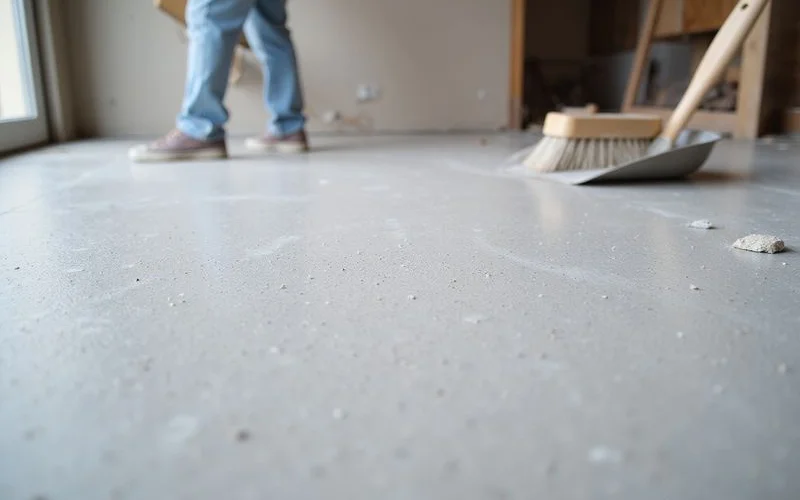
Everything that is not concrete comes off. Carpet and underlay, tack strips, tile and thinset, vinyl and mastic, existing sealers and coatings, paint, and adhesive residue of every kind.
This stage is messy and it is where the surprises live. Under a tiled floor we regularly find a second, older adhesive layer. Under carpet we find patched trenches nobody mentioned. Occasionally we find that the slab was never intended to be seen and has been treated accordingly.
Removal is also where the scope can legitimately change. If we find something that alters the work, we tell you before continuing rather than after.
Step Two: Mechanical Profiling
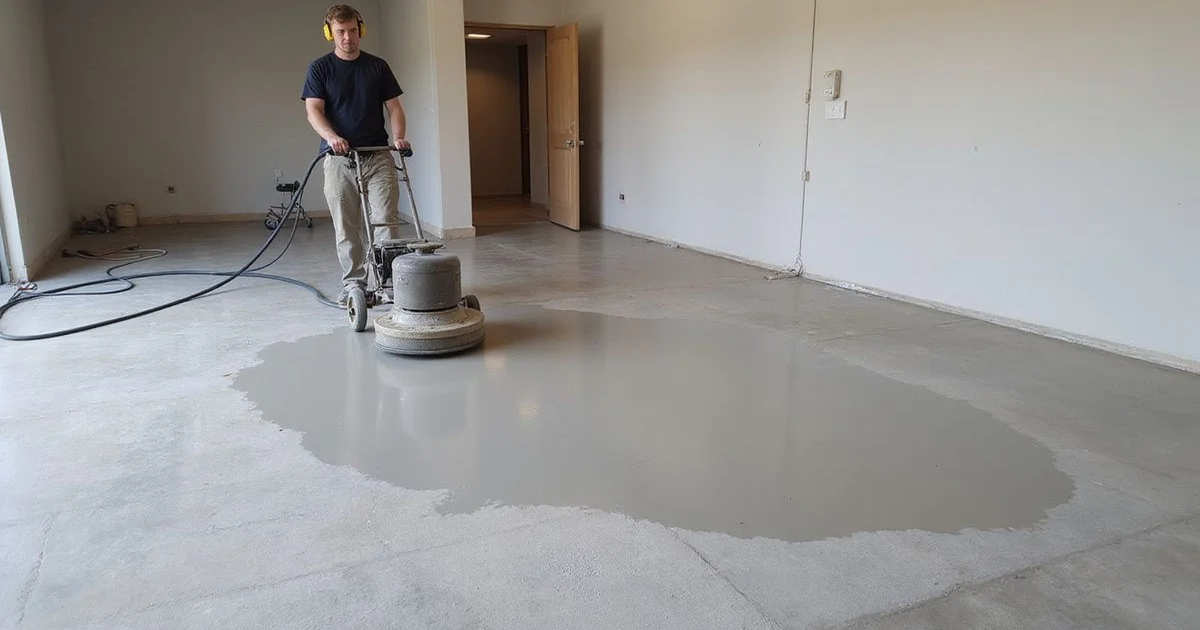
Then the slab gets ground. Diamond tooling on a planetary grinder, run with dust extraction, until the surface is open, clean, and consistent.
Profiling does three jobs at once. It removes the last of the residue and the weak surface paste. It opens the pores so stain can penetrate rather than sit on top. And it evens out the difference in absorbency between areas that have been covered, exposed, patched, or polished by foot traffic over decades.
Dust control matters here and it is not a housekeeping preference. Grinding concrete produces respirable silica, which is a genuine health hazard. Extraction runs on the equipment throughout.
Why an acid wash is not preparation
Consumer guidance often suggests etching a slab with an acid wash before staining. It dissolves some surface paste and it does not create a comparable profile to mechanical grinding. It can also leave salts behind in the surface, which show up later as whitening under a sealer. We grind.
Step Three: Repairs and Decisions
With the slab bare and open, you can finally see what you are working with. This is the right moment to decide about cracks, tack-strip holes, and patches.
Some of it is straightforward: filling holes, treating dormant cracks, dealing with spalled edges. Some of it is a judgement call about how much slab character you want visible, and this is a conversation rather than a technical decision. A floor with visible history has a particular look. A floor where everything has been filled and levelled has another.
Where the answer is “I want none of this to show”, the honest recommendation is often a microtopping rather than a stain, and we will say so even though it changes the job.
Step Four: Colour
Only now does anything get coloured.
Reactive acid stains are applied and left to react, then neutralised and rinsed according to the product’s requirements, because leftover acidity interferes with the sealer bond. Water-based stains and dyes are applied and allowed to dry, with technique driving how even the result looks. Layered effects, where a reactive base is followed by a dye, need both products to be compatible and the timing to be right.
Product compatibility is not a detail. Stain, sealer, and any subsequent maintenance product all have to belong to systems that work together, and installer-reviewed manufacturer guidance is what settles that rather than general trade folklore.
Step Five: Sealing
The sealer determines how the colour reads, how the floor feels, how much light it throws around, and how it wears. Coats go on with drying time between them, and the number of coats is a specification decision rather than a variable to be trimmed on site.
Then the floor cures. Light foot traffic returns before furniture does, and furniture returns before you should be dragging anything across it.
What to Ask Any Contractor
Four questions separate a real scope from an optimistic one. What preparation is included, and is removal priced? Are you grinding, and to what extent? How many sealer coats are in the price? What is excluded?
If you are still working out whether your floor is a candidate at all, start with whether your existing concrete can be stained. The preparation answer follows from that one.