
The Problem With Comparing Quotes
Three quotes for stained concrete floors can span a factor of three, and every one of them can be honest. They are pricing different work.
The trade has no standard scope. “Stained concrete floor” can mean a full removal, grind, repair, test, stain, and two-coat seal, or it can mean a clean and a spray. Both are described the same way on an invoice. This guide is about making the difference visible before you sign rather than after.
If you have not yet read what drives the cost, start there, because knowing the drivers is what makes the questions below land.
The Six Questions
1. What preparation is included, and what happens if you find something?
Removal, profiling, and residue removal are the bulk of the work. Ask whether they are grinding mechanically, how many passes, and what the process is if something unexpected turns up under the old covering. A contractor who has never had a surprise under a tiled floor has not removed many tiled floors.
2. Will you run a test area on my slab?
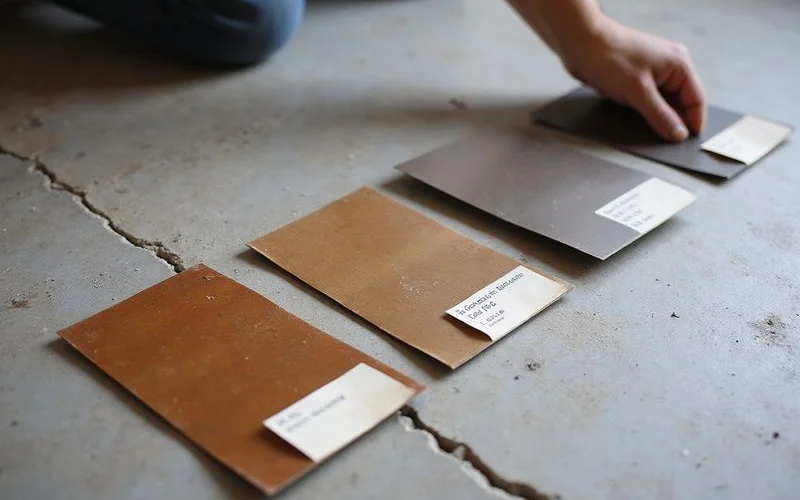
Reactive stain reacts with your concrete’s chemistry. A test area is the only honest preview, it takes very little time, and a refusal tells you something.
3. Which products, and how many sealer coats?
Named products, not categories. The sealer decision drives sheen, traction, maintenance, and cost, and coat count is one of the easiest things to quietly reduce.
4. What is excluded, and is there a minimum charge?
Exclusions are where quotes hide their differences: furniture moving, skirting protection, crack repair, transitions, disposal of the old covering. Ask for them in writing.
5. What does the warranty actually cover?
There is a large difference between a workmanship warranty covering application defects and a promise about how the floor will look in five years. Ask what would and would not be covered, particularly around wear, colour change, and moisture-related failure.
6. Can I see comparable work?
Not stock photos. Their own work, ideally on a slab in similar condition to yours. If a contractor’s portfolio is all pristine new-build slabs and yours is a 1970s house with patched trenches, you are not looking at a comparable result.
A warning sign worth taking seriously
A contractor who quotes without asking what is currently on the floor, what is underneath it, or whether there is any history of moisture is quoting a product rather than a project. That quote will change on site, or the floor will.
Reading a Written Scope
A good scope answers, on paper: what is removed and disposed of, how the slab is prepared, what repairs are included, what product and colour approach, how many sealer coats and which product, what the access and clearance requirements are, what is excluded, what the schedule looks like, and what the payment terms are.
If a quote is a single line and a number, ask for the detail before comparing it to anything. Most contractors will provide it. The ones who will not have told you something useful.
Checking the Basics
Confirm the business identity and that it is who you think it is. Ask about insurance appropriate to work inside your home. Check that dust extraction is part of the process, because grinding concrete produces respirable silica and that matters for the people in the house as well as the crew.
Ask about references and speak to one if the job is significant. Ask specifically what went wrong on that project and how it was handled, because every job has a moment, and the answer tells you more than a five-star rating does.
What We Would Say About Ourselves
We publish our editorial and evidence standards openly, we quote from your slab rather than from an average, and we will tell you when your floor is a poor candidate for staining even when that costs us the job.
We do not publish invented reviews or borrowed before-and-after photos, which means our proof looks thinner online than some competitors’. That is a deliberate trade. Judge us on the guidance and on the questions we ask before quoting.