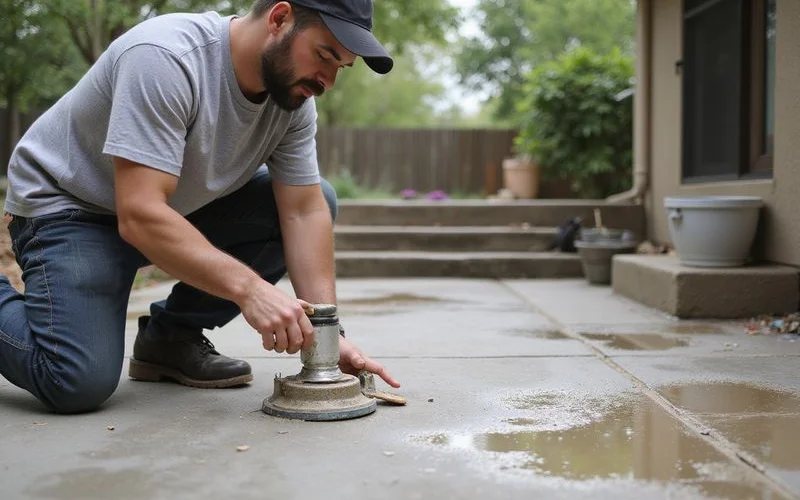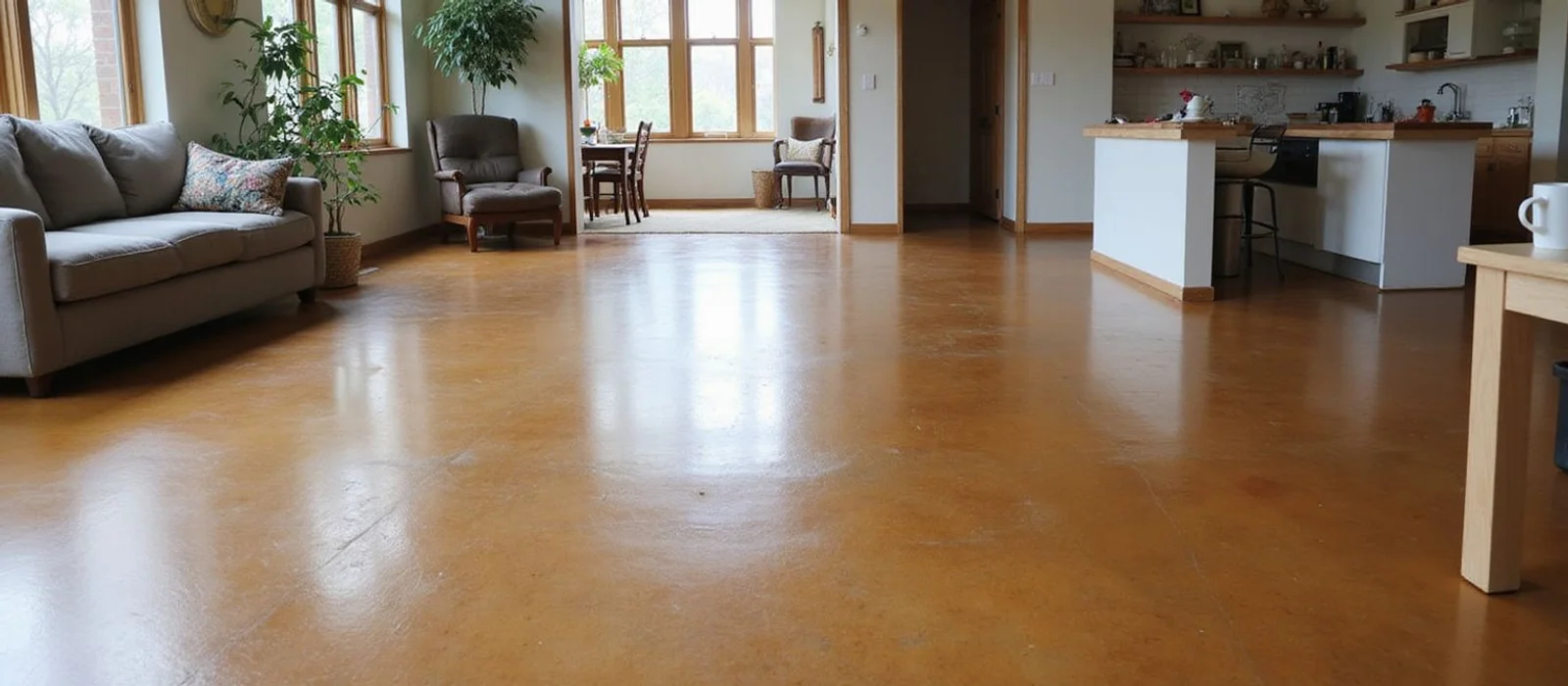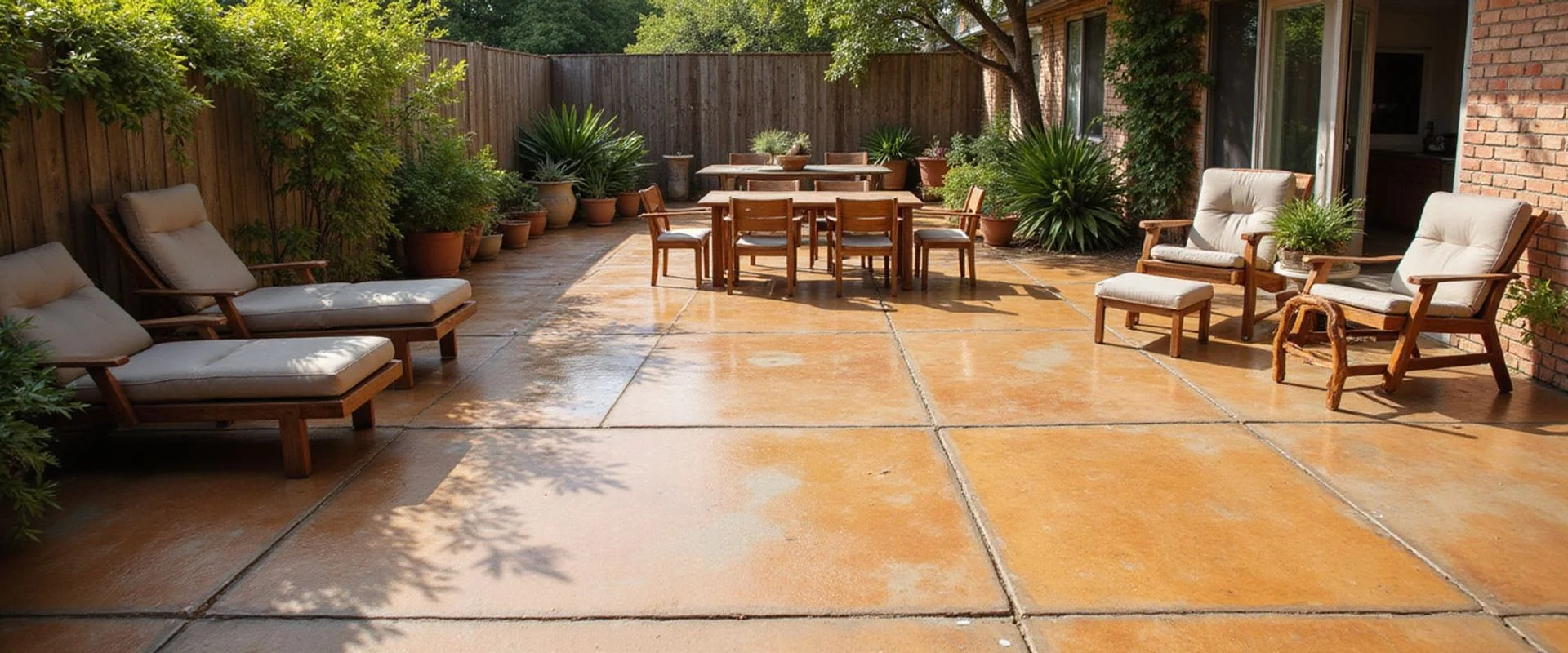
Austin Stained Concrete Floors has worked on exterior concrete surfaces across the Austin metro since 2001. Patios are a core part of that exterior work: they are the gathering and living space that connects a home to its outdoor environment, and in Central Texas they face sustained UV exposure, heat cycling, rain, and the physical demands of outdoor entertaining. The materials and methods that produce a durable, attractive interior stained floor do not simply carry over to a patio. Every element of the specification changes when the surface is outdoors, exposed year-round, and used barefoot.
This page covers what makes patio concrete staining distinct from interior work, what a slab assessment involves, how finish and sealer choices account for heat and traction, and what to expect for cost, timeline, and long-term care.
What Makes a Patio Different from an Interior Floor
The biggest difference between a patio and an interior floor is exposure. An interior slab sits in a conditioned, protected space; a patio is outdoors continuously, subject to direct Austin sun, rain, temperature swings between winter and summer, biological growth from leaves and algae, and the physical demands of outdoor use. Those conditions require a different product class for every layer of the system.
UV exposure is the most significant driver of finish degradation on exterior concrete. Many film-forming sealers and some dyes degrade in prolonged direct sunlight: sealers turn chalky or yellow, and topical colour systems fade from the surface rather than from within the concrete. Reactive acid stains, which create colour by chemically reacting with the concrete itself, are inherently more UV-stable than topical dyes because the colour is locked into the mineral structure of the slab. Sealer choice matters equally: we specify a UV-stable exterior product for every patio, not an interior-grade sealer applied outdoors.
Thermal cycling is the second key factor. Austin summers bring sustained temperatures that heat concrete surfaces well beyond the air temperature. A dark horizontal patio in full afternoon sun can reach temperatures uncomfortable or unsafe for barefoot use. That is a real decision point: we raise the surface-temperature question before colour is chosen so the decision is made with complete information. Beyond comfort, repeated thermal expansion and contraction stresses any coating or slab system, and expansion joints that have deteriorated or been bridged by a previous coating become failure points for any new finish applied across them.
Drainage is the third consideration. Water that pools on a patio surface does not drain away, sits in contact with the finish, penetrates surface cracks, promotes biological growth, and accelerates weathering. Before we specify any finish, we look at where the water goes and address gradient problems as part of the scope rather than leaving them as an ongoing problem underneath a new decorative layer.
The Sealer Difference for Patios
Interior penetrating acrylics and standard polyurethanes are not suitable products for patio surfaces in Central Texas. They lack adequate UV stability and do not perform through the temperature range a patio experiences across a full Austin year. An exterior-rated sealer is a distinct product class designed for outdoor concrete: it needs to handle UV degradation, water, biological growth, thermal movement, and foot traffic simultaneously. We name the product category in the scope, specify the coat count, and include a slip-resistant additive where traction is needed, so the sealer specification is transparent and comparable across quotes.
Is Your Patio Slab a Candidate?
The slab assessment for a patio covers the same basic ground as any concrete assessment but with different priorities. For an interior floor, the main concerns are adhesive residue, porosity, and whether existing coatings block stain penetration. For a patio, surface condition from outdoor weathering, the drainage gradient, expansion joint condition, and any prior sealers or paint take priority.
Surface Condition from Outdoor Weathering
Outdoor concrete weathers differently from interior slabs. Surface scaling and spalling, where the top layer breaks down and flakes, is common on patios that have been through Austin freeze-thaw cycles or that were placed with a surface treatment that trapped moisture. Light surface spalling can be addressed with preparation, but deep or progressive spalling indicates a surface layer that has separated from the slab below, and resurfacing or staining over it replicates the problem in the new finish.
Previous sealers are a significant variable. A patio sealed with an incompatible product, or one that has failed and trapped moisture below, needs that material removed before any new system can be applied. We test adhesion and assess the existing sealer condition during the site visit.
Cracks and Expansion Joints
Hairline shrinkage cracks are largely cosmetic and read as natural variation under a translucent stain. Moving cracks, settled sections, or cracks that track drainage or root growth are a different category and need structural attention before any decorative finish is applied. A decorative stain or overlay applied over an active crack will replicate that fault line in the new surface, typically within the first season.
Expansion joints on a patio manage thermal movement in a slab that heats to much higher temperatures than any interior floor. If joints have been filled with a rigid material, bridged by a previous overlay, or have begun to crack at the edges, that informs both the preparation scope and the finish specification. We treat expansion joints as part of the scope rather than ignoring them.
Textures, Finishes, and Heat
For a patio, finish and texture decisions are guided by three factors in roughly this order: traction, surface temperature, and appearance.
Traction for Outdoor Use
Wet patio concrete is a common cause of slips and falls. A smooth, glossy finish is visually appealing and becomes slippery when wet, particularly on any surface near a pool, a hose connection, or a shaded area that stays damp longer after rain. A light to medium broom texture or a knockdown finish provides grip without making the surface difficult to clean. Slip-resistant additives broadcast into the sealer topcoat provide an additional level of traction where it is most needed: steps, pool surrounds, and any sloped area.
Surface Temperature and Colour
Colour is a heat decision on a patio. Dark surfaces absorb substantially more solar radiation than lighter ones. A near-black stained patio in direct Austin afternoon sun reaches temperatures that are genuinely uncomfortable underfoot for adults and potentially hazardous for children and pets. We do not discourage darker colours, but we raise the temperature question as a function of orientation, shade, and how the patio is used, so the decision is made with complete information rather than from a sample card alone.
Texture moderates surface temperature at the margins. A textured surface holds less continuous heat than a smooth, dense one, and combined with a mid-tone or lighter colour, produces a surface that remains comfortable through a Central Texas summer.
Earthy and neutral tones, warm tans, ochres, and stone greys, suit most Austin homes and age well in an exterior environment. Reactive acid stains produce mottled, mineral variation that reads naturally in an outdoor setting and tends to hold its character as it weathers. Water-based stains and dyes offer more consistent tones where a specific colour family is the goal.
How Much Does Staining a Patio Cost in Austin?
We do not publish a fixed price per square foot for patio staining because the number that matters for your project depends on conditions. A straightforward rectangular patio on a sound slab with good drainage and no prior sealers is a different scope from an irregular patio with settled sections, a failed coating, and drainage that pools against the house foundation.
The main cost drivers are patio size and shape, including any steps, borders, and connected walkways that should match; existing slab condition and the preparation it requires; whether direct staining or an overlay is the right starting point; texture specification; sealer system with a UV-stable exterior product always specified for outdoor work; drainage corrections if needed; and access and scheduling logistics including the cure window before the patio returns to full use.
Two quotes that look similar can diverge significantly on preparation scope. We scope preparation explicitly, disclose minimum charges, and list exclusions so you can compare our proposal against any other honestly.
Sealers and Long-term Care
An exterior-rated UV-stable sealer is a non-negotiable specification for a patio in Central Texas. The UV index in Austin is high for much of the year, and a sealer without adequate stabilisers chalks and degrades within a few seasons, leaving the stained surface unprotected and harder to restore.
We do not publish a universal resealing interval for patios. The right renewal schedule depends on exposure, traffic, and maintenance. A shaded patio with moderate foot traffic holds its sealer longer than one in full afternoon sun with heavy use. We hand over maintenance guidance matched to the system we install and the actual conditions your patio faces.
Routine care for a stained patio is practical: sweep off organic debris regularly since leaves and damp pollen left on the surface promote biological growth; rinse periodically; clean organic growth with a suitable diluted product rather than harsh acids that attack the sealer; and avoid directed high-pressure washing at film-forming sealers. The main signals that sealer renewal is warranted are water no longer beading on the surface, colour appearing dull or chalky, and the surface becoming harder to clean after weathering.
Stained Concrete Patios Across Austin
Austin Stained Concrete Floors works on patios across the Austin metro and surrounding Central Texas communities. Patios in Westlake Hills, Tarrytown, and Travis Heights often involve mature concrete that has seen prior sealers, weathering, and in some cases previous decorative attempts. Patios in Cedar Park, Leander, and Round Rock are frequently on newer builds with tighter concrete that is less porous and requires a different staining approach. Properties in Pflugerville, Manor, and Kyle range across a variety of ages and slab conditions.
We assess each patio on its own conditions rather than applying a standard approach based on neighbourhood or construction date. If you are comparing a stained patio against other exterior concrete options, patio resurfacing covers the full range of overlay and resurfacing approaches for exterior slabs, and stained concrete floors explains the staining process in more depth for interior applications.
Request a free stained concrete patio quote from Austin Stained Concrete Floors, and we will assess whether your slab is a sound candidate before committing to anything else.