Polished Concrete Is a Process, Not a Product
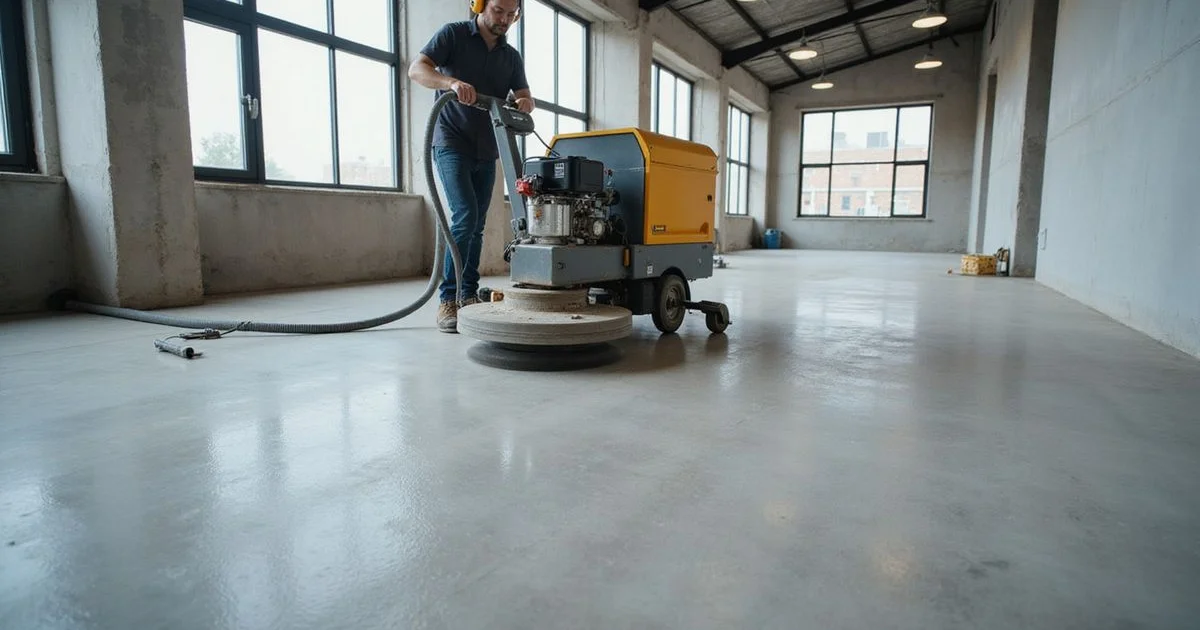
You cannot buy polished concrete in a can. It is produced by machine: the slab is ground with progressively finer diamond tooling, hardened partway through with a chemical densifier, and refined until the surface of the concrete itself reflects light.
That is the whole definition, and it is the reason polished concrete behaves the way it does. Nothing sits on top, so there is nothing to peel, blister, or wear through in a doorway.
The Grit Progression
The process runs through a sequence of diamond abrasives, coarse to fine.
Early passes use metal-bond tooling to cut. This is where aggregate exposure is decided, because how deeply the first cuts go determines whether you see only the surface paste, fine sand, or the larger stone in the mix. Once the cut depth is set, it cannot be undone by later stages.
Middle stages move to resin-bond tooling, refining the scratch pattern left by each previous grit. Every stage exists to remove the marks of the one before, which is why skipping steps produces a floor that looks hazy rather than clear.
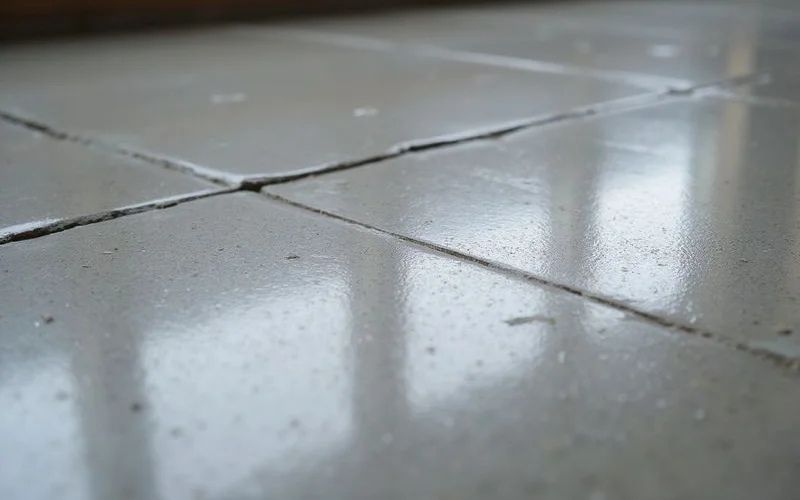
Final stages build the sheen. By this point the machine is polishing rather than cutting, and the surface is developing genuine reflectivity.
Densification
Somewhere in the middle of that sequence, a lithium silicate densifier is applied. It penetrates the surface and reacts with free lime in the concrete to form additional binder, hardening the surface so it can take a higher polish and resist wear.
This is not optional and it is not a sealer. A densified floor is harder and less porous than it was, but it is still concrete, not a coated surface.
How to tell what you are being sold
Ask what densifier is used and at which grit stage. Ask how many grit stages are included. A quote that cannot answer either is a grind-and-seal quote, which is a different product at a different price. That comparison is covered in polished concrete versus grind and seal.
The Two Variables That Define Your Floor
Aggregate exposure. A cream finish barely removes the surface paste and keeps the floor even and quiet. Salt-and-pepper reveals fine sand and small stone. Full exposure brings the larger aggregate forward for a look close to terrazzo. Which one is achievable depends on your slab: how it was poured, how it was finished, and how deep the aggregate sits.
Gloss level. Commonly described from one to four, matte through to highly reflective, and set by how far the grit sequence runs. Higher gloss means more passes and more cost, and it also means a floor that shows more.
These two are independent. You can have a low-gloss floor with full aggregate exposure or a high-gloss cream finish.
What a Polished Floor Is Good At
It takes heavy foot traffic without a coating to maintain. It cleans with water and a neutral cleaner. It reflects light, which is useful in spaces with limited glazing. It does not off-gas, harbour dust, or need periodic stripping and recoating. And in commercial settings, the long-term maintenance cost is genuinely lower than almost any alternative.
What It Cannot Do
It cannot make a poor slab good. Polishing reveals what is there: soft spots, patches, trenches, and unevenness all become more visible once the surface is refined, not less. It cannot be applied to an overlay expecting the same result, since there is no aggregate to expose. And it cannot be rushed, because each grit stage takes the time it takes.
It is also not a colour process. Dye can be introduced during polishing, but if warm, translucent, variegated colour is what you are after, staining is the route rather than polishing.
Is Your Slab a Candidate?
The honest answer comes from an inspection. We look at hardness, flatness, the extent of patching, joints and saw cuts, and whether anything is bonded to the surface. That assessment determines realistic aggregate exposure and realistic gloss, and it happens before we quote rather than after we start.