Why Maintenance Is Simple Here
A polished concrete floor carries no topical film. That single fact removes most of the maintenance burden other floors carry: nothing to strip, nothing to recoat on a schedule, nothing to peel at a doorway.
What remains is straightforward, and it comes down to keeping abrasive material off the surface and using cleaners that do not attack it.
The Routine
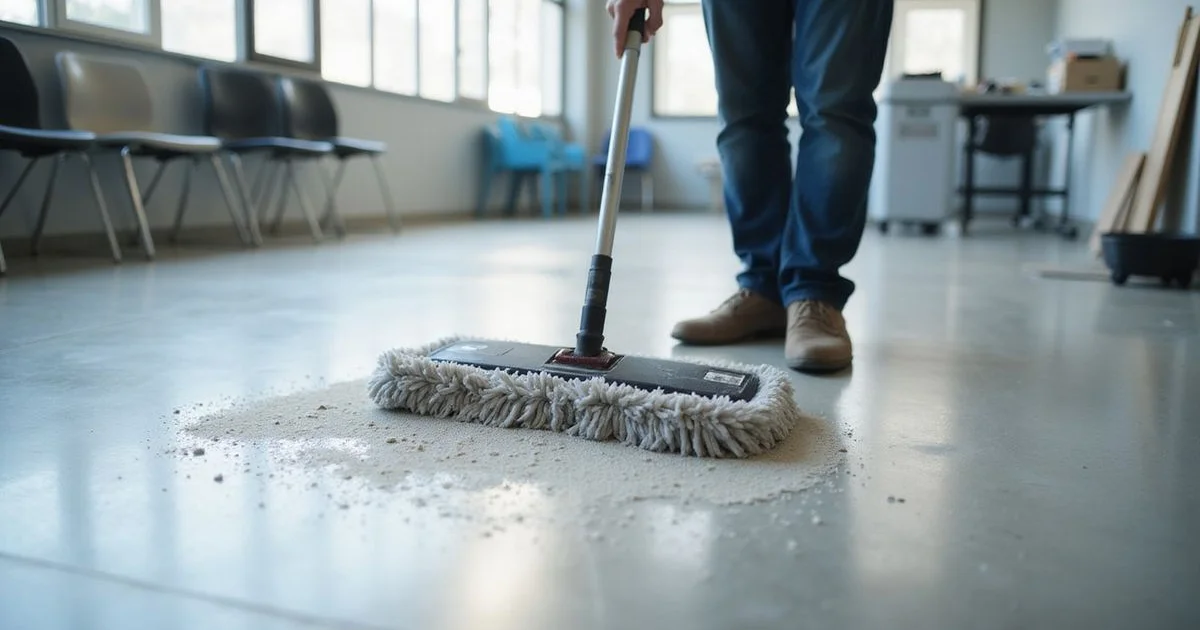
Daily or as needed: dust mop with a microfibre head, or vacuum with a hard-floor setting. The point is grit removal. Sand and dust tracked in from outside act like fine abrasive under every shoe, and traffic paths dull from that far more than from anything else.
Weekly, or more often in commercial settings: damp mop with a pH-neutral cleaner, properly diluted, and change the water before it turns into a grit solution you are spreading around.
At the entries: walk-off mats inside and out. In a commercial space this is the single highest-value maintenance decision, and it costs less than any cleaning programme.
Spills: wipe promptly. Concrete is porous even when densified, and acidic liquids can etch it if left.
What to Keep Away From It
Acidic cleaners are the main hazard. Vinegar, citrus-based products, and anything designed to dissolve mineral deposits will etch a densified surface, leaving dull patches that cleaning cannot fix.
Strong alkaline cleaners and coating strippers are the other group to avoid. They are formulated to break down films, and on a polished floor there is no film to break down, so they simply attack the surface.
Abrasive pads and scouring powders scratch the polish. So do dragged furniture legs, unprotected appliance feet, and rolling loads with hard, grit-embedded wheels.
The mistake that costs the most
Using a general-purpose “concrete cleaner” bought off a shelf. Many are formulated for driveways and are deliberately aggressive. On an interior polished floor they can etch the surface within one application.
Burnishing and Re-Polishing
Over time, traffic paths lose some of their sheen. This is normal and it is not a failure, because the floor is being abraded rather than a coating wearing through.
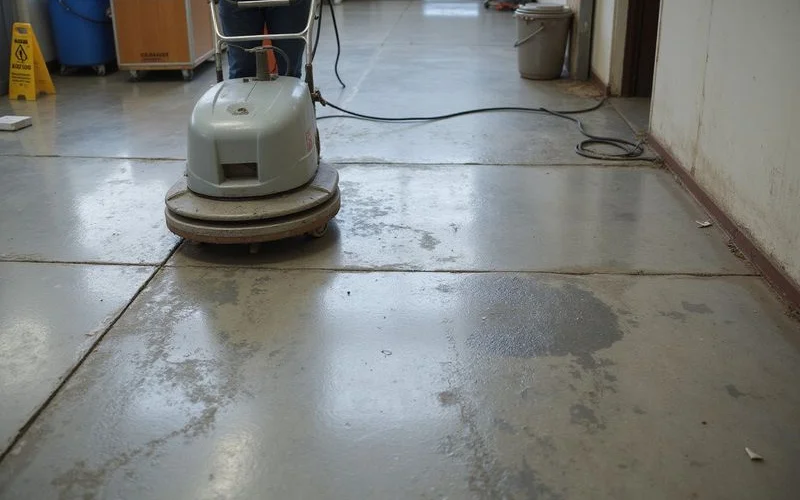
Burnishing uses a high-speed machine with a soft pad to restore gloss in those areas. It is quick, it is inexpensive relative to any recoating process, and in commercial settings it is often scheduled as routine maintenance.
Re-polishing returns to the finer grits and refines the surface again. It is a larger job, used when a floor has been neglected or heavily worn, and it can bring a tired floor back close to its original finish.
Neither involves adding material to the floor, which is why a polished floor’s long-term cost of ownership compares so well.
Stain Guards and Protective Treatments
Some polished floors receive a stain-resistant treatment after polishing, particularly in food service, hospitality, and other settings where spills are constant. These are not sealers in the film-forming sense, and they wear and are renewed on their own schedule.
If your floor has one, the cleaning guidance should account for it, since some products are more sensitive to particular chemicals than bare densified concrete is.
Commercial Programmes
For retail, hospitality, and warehouse floors, a written maintenance schedule pays for itself. It typically covers daily dust mopping, an auto-scrubber pass with a neutral cleaner at a defined frequency, mat maintenance at entries, and a periodic burnish.
The alternative is the pattern we see most often: excellent maintenance for six months, then nothing, then a call about a dull floor two years later that needs a re-polish rather than a burnish.
Common Damage and What to Do
Etch marks from acidic spills show as dull patches. They are a surface change rather than a deposit, so cleaning will not remove them. Small ones often blend in over time; larger ones are addressed by localised polishing.
Scratches from dragged furniture or grit under a heavy load are usually shallow and respond to burnishing. Deeper gouges need the finer grits revisited in that area.
Rust marks from metal furniture feet left on a damp floor can penetrate, particularly on a floor without a stain guard. Address them early rather than after weeks of moisture.
Oil and grease in a garage or workshop setting will sit in the surface if not dealt with promptly, since a densified floor is still porous.
The general rule is the same as everywhere else in decorative concrete: do not escalate. An aggressive product applied to a small blemish usually creates a larger, duller area that is more work to correct than the original mark.
Before You Choose a Gloss Level
Maintenance appetite should inform the specification, not just follow it. A high-gloss floor shows more and rewards discipline. A satin floor is more forgiving of a normal household. That trade-off is covered in polished concrete gloss and aggregate levels, and it is worth deciding honestly before the machine starts rather than after.