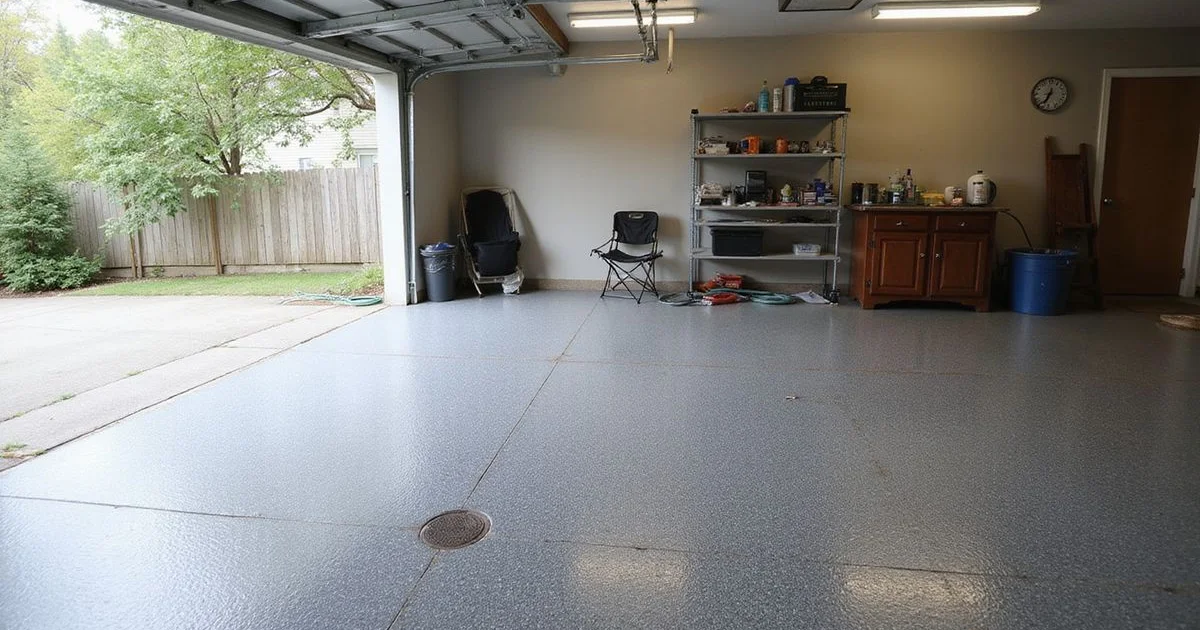
Why Garage Slabs Are Their Own Category
A garage floor takes punishment nothing inside the house comes close to: tyres hot off a Texas highway, dropped tools, oil and brake fluid, grit dragged in from the driveway, and standing water every time it rains.
It is also usually the least carefully finished slab on the property. It falls toward the door, it has control joints running through the middle, it often has pitting near the apron, and it was never intended to be looked at.
All of which makes it an excellent candidate for a coating, and a poor candidate for a coating applied carelessly. This sits within our epoxy floors service, and the specifics below are what makes a garage job different.
Flake Systems and Why They Dominate
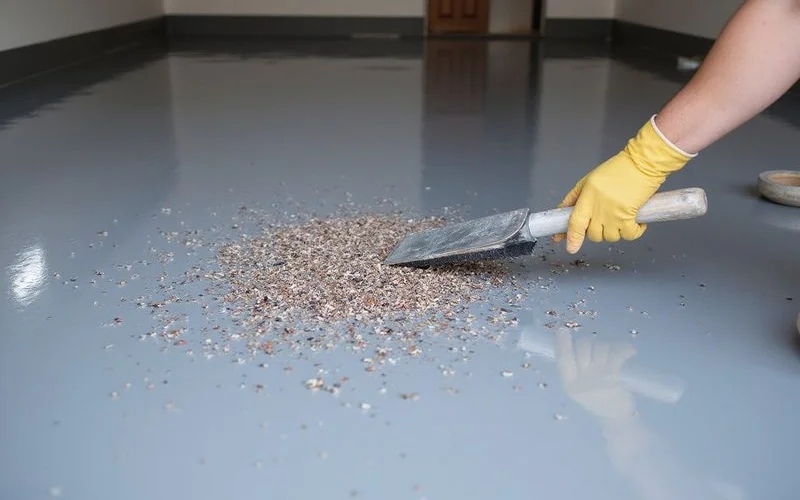
A flake system works like this: a pigmented base coat goes down, vinyl chips are broadcast into it while wet, and once cured the excess is scraped back and a clear topcoat seals everything in.
The result does several things a solid colour does not. The texture gives grip. The visual noise hides dust, tyre marks, and the minor imperfections every garage slab has. And the chip layer adds a little build to the system.
Chip density is a choice. A light broadcast leaves the base colour dominant. A full broadcast, where chips cover the surface completely, gives the most texture and the most forgiving appearance, and it costs more in material and labour.
Hot Tyres, Honestly
Hot-tyre pickup is the failure people ask about most, and it deserves a straight answer.
When a tyre comes off a hot road it is soft, and the plasticisers in the rubber attack coatings. If the coating is weakly bonded, under-built, or not fully cured, the tyre lifts it. What is left looks like the coating was peeled off in patches, because it was.
The defence is not a magic product. It is a proper mechanical profile so the coating is genuinely bonded, adequate film build so there is material to resist, a topcoat suited to the exposure, and a full cure before the car comes back. Polyaspartic topcoats perform noticeably better here, which is why they are common in Texas garages.
The single most common cause of failure
Parking on it too early. The floor feels hard long before it is fully cured, and a hot tyre on a floor that is nearly there will mark it permanently. Ask for both dates: when you can walk on it and when the car can come back.
Preparation and Moisture, Again
Garage slabs sit directly on ground and often have less effective vapour control than an interior slab. Moisture testing is not optional, and it is covered in detail in slab preparation and moisture testing before epoxy.
Preparation is diamond grinding, every time. Acid etching a garage floor before coating is the most common consumer shortcut, and it is the reason so many DIY kits fail within two years.
Expect repairs too. Pitting near the apron, spalling around the door line, and open control joints all need attention before a coating goes over them, because a coating bridging a moving joint will crack along it.
One Day or Several?
| Fast polyaspartic system | Standard epoxy build | |
|---|---|---|
| Install time | Often one day | Two to three days |
| Foot traffic | Same day, typically | Next day |
| Vehicle traffic | Around 24 hours | Several days |
| Cost | Higher | Lower |
| UV stability | Better | Ambering over time |
Neither is universally better. If the garage is the only access to the house, the fast system earns its premium. If it can be left alone for a week, the epoxy build is more economical.
What to Ask For
A named system for each layer, the grinding profile, the moisture testing method, the chip density, whether a slip additive is included, and the two cure dates. Then ask what happens if the moisture test comes back high, because the honest answer, which is that the specification changes, tells you they are actually going to run the test.