Read the Floor, Not the Calendar
There is no schedule for resealing a stained concrete floor, and the widely quoted intervals circulating online are guesses applied to floors nobody has seen.
What there is instead is a set of signals. Learning to read them tells you when to act, and acting early is what keeps a maintenance visit from becoming a floor restoration.
The Signals That Say “Reseal”
Water stops beading. Drop a little water on a suspect area. On a healthy sealed floor it sits as a bead. On a worn one it spreads and darkens the surface temporarily. That darkening is liquid reaching the concrete.
Traffic paths look flat. Compare the middle of the walkway with the area under a piece of furniture or against the wall. A visible difference in sheen means the sealer has thinned where you walk.
Marks linger. Spills that used to wipe away now need effort, or leave a faint shadow.
The floor looks tired when clean. If a properly cleaned floor still looks dull in raking light, it is not a cleaning problem.
Any of those, with the colour still intact underneath, points to a reseal. That is the good outcome: a manageable job that restores appearance and protection.
The Signals That Say “Restoration”
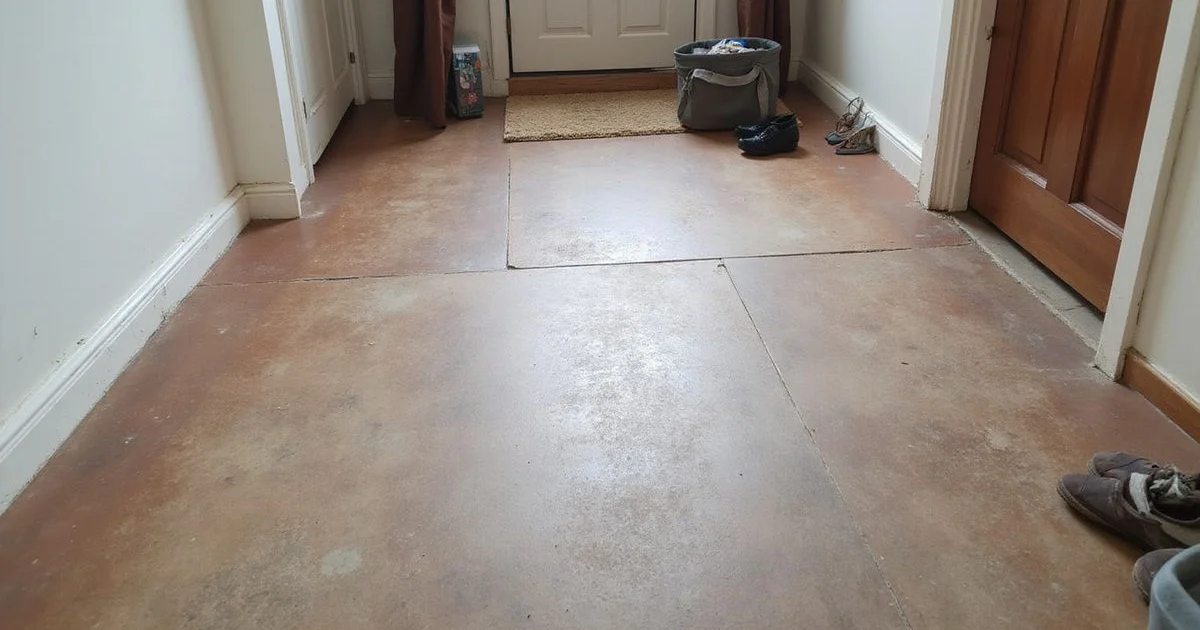
Colour is worn through. Traffic paths are lighter than the rest of the floor in the colour itself, not just the sheen. The stained surface layer has been abraded away.
The sealer is peeling rather than thinning. Flaking, lifting at edges, or coming away in sheets means a bond failure, not wear, and a new coat over it will fail the same way.
Whitening or cloudiness. This points to moisture, and moisture needs resolving before anything else happens.
Damage below the sealer. Etching, deep scratching, or staining that has reached the concrete cannot be covered by a new coat.
Those signals mean the finish itself needs reworking rather than re-protecting. The scope difference is covered in resealing versus full floor restoration.
Why waiting costs more
A sealer refreshed while it is still continuous is a straightforward job. A sealer left until it has worn through in the traffic paths exposes the colour to abrasion and staining, and at that point you are paying to restore colour as well as protection.
What Accelerates Wear
Grit is the main one. Sand and dust under shoes abrade any surface. Mats inside and out are the highest-value intervention available and they cost almost nothing.
Harsh cleaners attack sealers directly. Acidic products, strong alkalis, and anything designed to strip a coating all shorten sealer life, sometimes dramatically.
Dragged furniture scratches the film. Felt pads and lifting rather than sliding solve it.
Sunlight ages both sealer and colour in the zones it reaches, which is why the area in front of a west-facing window often looks a year or two older than the rest of the room.
Neglect is the cumulative one. A floor cleaned properly and protected at entries can outlast an identical floor in a neglected house by years.
Can You Reseal It Yourself?
Sometimes, and the deciding factor is whether you know what is already on the floor.
A sealer applied over an incompatible existing product can cloud, refuse to bond, or lift the layer beneath it. Since most people do not have records of what was used, particularly on a floor installed by someone else or before they moved in, the honest first step is a test area in an inconspicuous spot rather than a confident afternoon with a roller.
The other common DIY problem is application rather than product. Sealers show lap marks, roller texture, and uneven build far more readily than paint does, and a floor with visible application lines is harder to correct than one that was simply dull. Working a wet edge across a large open area takes practice.
Where a floor has a straightforward penetrating sealer, a well-prepared DIY refresh is reasonable. Where there is a film-forming system, an unknown history, or a large open area, the odds shift.
If in doubt, ask before you apply anything. Diagnosing what is on a floor is quick, and it is considerably cheaper than removing a product that has gone on over the wrong thing.
How Often to Check
Look at your floor properly twice a year, in the way described above: bead test, compare traffic paths with protected areas, and look at it in raking light after cleaning.
That habit catches a reseal while it is a reseal. It is also how you learn your own floor’s rhythm, which is more useful than any published interval could be.