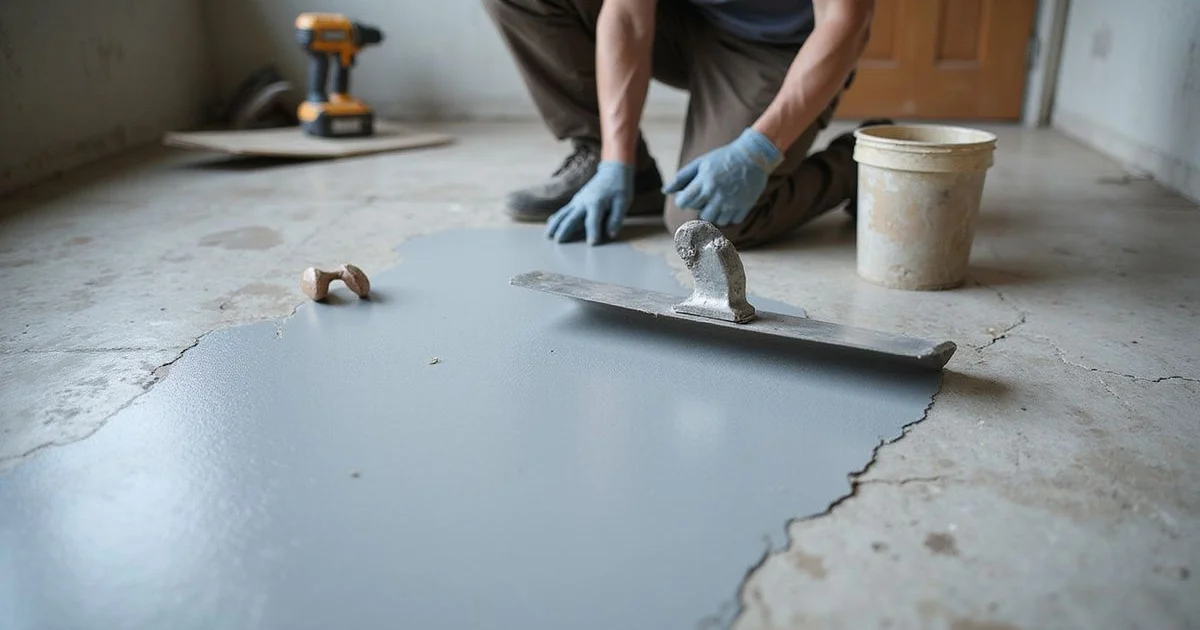
What an Overlay Is
An overlay is a thin cementitious layer applied over existing concrete to create a new decorative surface. Polymer modification gives the mix the flexibility and adhesion to be applied that thinly without simply cracking off, which a traditional sand-and-cement screed would do.
Within overlays and microtoppings there are three broad systems, distinguished mostly by thickness:
- Microtopping. A skim, often a millimetre or two, renewing the surface appearance with almost no height gain.
- Decorative overlay. Thicker, able to carry texture such as knockdown or hand-troweled finishes and absorb more surface irregularity.
- Self-levelling underlayment. Poured to correct flatness, usually as a base for a final decorative treatment.
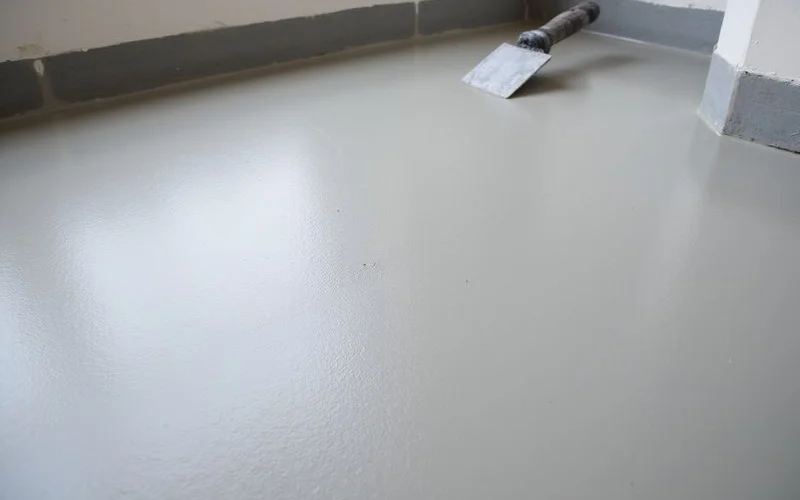
What Overlays Genuinely Fix
Surface appearance. A slab that is stained, discoloured, scarred by adhesive, or simply tired gets a fresh, even face.
Colour inconsistency. This is the big one. A slab with patches, a filled trench, and thirty years of different exposure will never take reactive stain evenly. An overlay gives a uniform canvas where colour behaves predictably.
Unwanted texture. An old broom finish, a heavily power-trowelled surface, or a floor with a coating pattern ground into it can be given a new texture entirely.
Minor surface damage. Shallow spalling, light pitting, and superficial scarring disappear under the new layer.
Aesthetic direction. Overlays can carry textures, scoring, and pattern work that a bare slab cannot.
What They Cannot Fix
Structural problems. This is the limit that matters most. An overlay is a decorative system bonded to the slab, and it moves with the slab. Settlement, active cracking, and slab movement will all reappear.
Significant unevenness. A microtopping follows the plane of the floor. If you need levelling, that is a self-levelling underlayment applied first, and it is a separate scope with its own cost.
Moisture problems. Vapour moving up through a slab affects overlays and their sealers as much as it affects any other system. Moisture gets resolved first or it gets accounted for in the specification.
A poor substrate. If adhesive residue, a curing compound, a failing coating, or loose material is left in place, the overlay bonds to that rather than to concrete. It then fails wherever that layer fails.
The honest framing
An overlay renews a surface. It does not renew a slab. If the concrete underneath is failing, an overlay buys you appearance for a while and nothing else, and we will tell you when that is the situation.
Crack Handling, Specifically
Cracks are the question we are asked about most, and the answer depends on whether the crack is finished moving.
A dormant crack, meaning one that has stabilised, can be treated, filled, and in some systems bridged with mesh so it does not telegraph through the new surface. This usually works.
An active crack, driven by settlement, expansive soil movement, or a structural issue, will re-open. Nothing thin and bonded stops that. Assessing which one you have is part of the pre-quote inspection, and it sometimes changes the recommendation entirely.
Substrate Requirements
Sound concrete is the standard substrate. It needs to be structurally stable, free of movement, and clean enough after preparation that the bond coat grips concrete rather than a residue.
Preparation typically means mechanical profiling, removal of any coating, sealer, or adhesive, and repairs to loose or spalled areas. Some other surfaces can be overlaid with the right system and preparation, and that needs assessment rather than assumption.
Height, Thresholds, and Transitions
The practical constraint people forget is height. Every system adds some, and where it meets something else, that has to be resolved.
A microtopping adds so little that most doorways and thresholds are unaffected, which is a large part of its appeal in a renovation. Thicker decorative overlays add enough to matter, and self-levelling systems add the most, particularly at the low end of a floor that is being brought to plane.
The places to check are internal doors and their undercuts, external door thresholds and weather seals, the transition to carpet, tile, or timber in adjacent rooms, kitchen kickboards and appliance clearances, and the top step where a floor meets stairs.
None of these is difficult to deal with when it is identified at quoting. All of them are awkward and sometimes expensive when they are discovered after the overlay has gone down. We raise them during the assessment, along with how each transition will be detailed, because an overlay that closes a door is not a finished job.
When an Overlay Is the Right Call
If your slab is sound but ugly, an overlay is often the best value decision available, because you get a new floor surface without replacing anything.
If your slab is failing, read overlays versus resurfacing versus slab replacement before spending anything, because the honest answer in that case is sometimes replacement, and it is cheaper to hear it now.