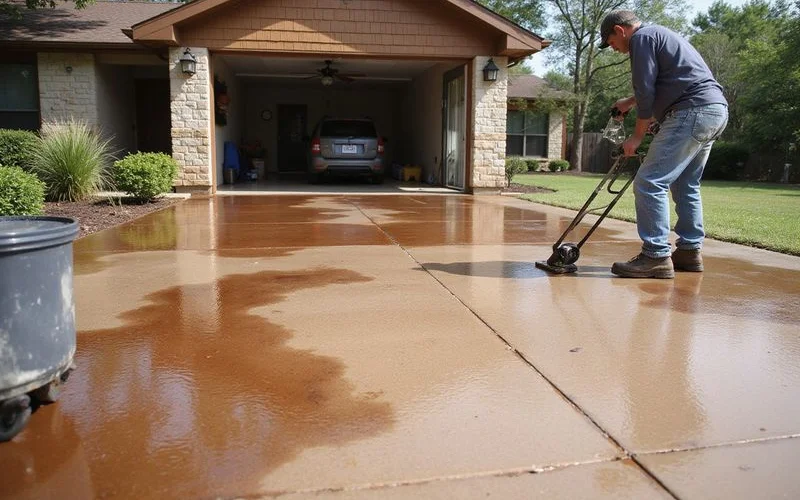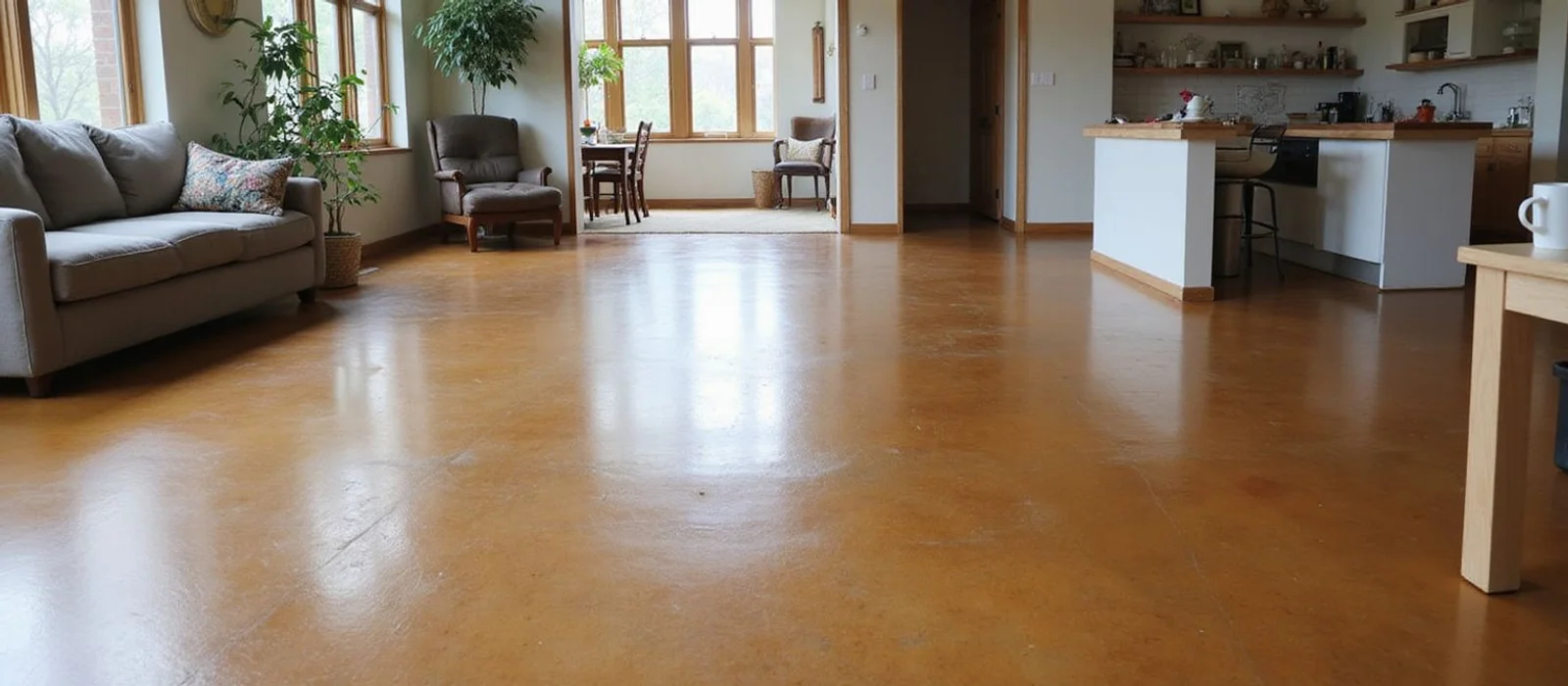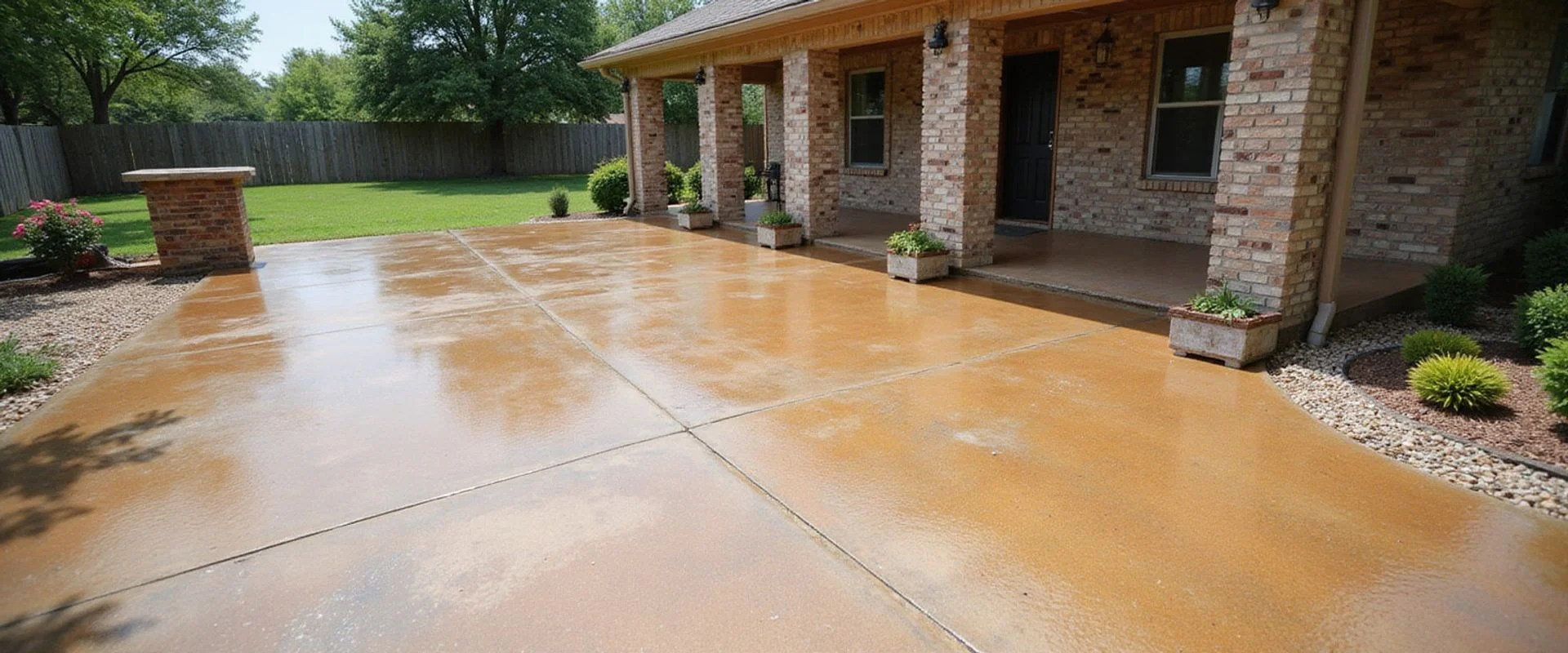
Austin Stained Concrete Floors has worked on exterior concrete surfaces across the Austin metro since 2001. Driveways represent some of the most demanding exterior concrete work in Central Texas: they carry vehicle loads, endure direct UV exposure through months of summer heat, manage oil and tyre chemistry, and have to drain water effectively while remaining safe for both pedestrian and vehicle use. The approach that produces a lasting interior stained floor transfers to a driveway in general principle but changes substantially in every technical detail.
This page explains what distinguishes stained concrete driveway work from interior applications, how we assess a driveway slab, what finish and sealer choices are available, and what realistic expectations look like for cost, timeline, and long-term care.
Stained Concrete Options for Austin Driveways
Two primary approaches exist for adding colour to an existing concrete driveway: direct staining of the existing slab, and staining applied over a polymer-modified overlay that creates a fresh surface. The right starting point depends on the condition of the existing slab.
Acid Stain vs Water-Based Stain for Driveways
Reactive acid staining creates colour by chemically reacting with calcium hydroxide in the concrete. The result is a translucent, mottled, mineral-looking finish with natural variation across the surface. Because the colour is locked into the concrete chemistry rather than sitting on top of it, acid staining is inherently more durable under UV exposure and more resistant to surface abrasion than topical colourants. For a driveway facing full Austin sun and vehicle traffic, that chemistry has practical significance beyond aesthetics.
Water-based stains and penetrating dyes work differently. They do not react with the concrete; they penetrate the surface and deposit colour in the pore structure. The result can be more consistent in tone where a specific colour family is the goal, but performance depends on an open, clean, uniformly porous surface. On a driveway that has seen oil, old sealers, or inconsistent curing, that consistent surface is harder to achieve.
Neither stain type affects how the sealer performs under vehicle loads, which is the critical variable for a driveway. The sealer specification is what distinguishes a driveway installation from an interior one, regardless of which colourant is used.
When a Polymer Overlay Makes More Sense
Where an existing driveway slab is too contaminated, damaged, or uneven to produce an acceptable result with direct staining, a polymer-modified overlay creates a fresh, consistent surface. The overlay is a factory-blended cementitious system applied in a controlled thickness that can be stained, textured, and sealed after it cures. It allows colour acceptance to be managed independently of the condition of the original concrete underneath.
An overlay is a practical tool but not a universal solution. It adds material over the existing surface, which affects drainage gradient and transitions at doors, garage thresholds, and adjacent walkways. The overlay itself needs to bond to a prepared substrate, and a slab with active movement, progressive cracking, or serious drainage problems will replicate those issues in the overlay if the underlying conditions are not addressed first. We explain what an overlay can and cannot do before committing to one.
Assessing Your Austin Driveway Slab
The slab assessment for a driveway covers the same general areas as any concrete assessment but with priorities specific to an exterior vehicle surface. For an interior floor, the main questions are adhesive residue, curing compounds, porosity, and whether existing patches and cracks are cosmetic or active. For a driveway, oil contamination depth, drainage gradient, expansion joint condition, and surface spalling from vehicle and UV exposure all take priority.
Oil and Chemical Contamination
Oil that has saturated a driveway slab from a parked vehicle blocks stain penetration and prevents overlay adhesion. The extent of contamination determines the preparation approach. Surface contamination from recent drips responds to degreasing and mechanical grinding. Long-term saturation from a chronic oil leak, fuel spills, or multiple vehicles over years can penetrate to a depth that grinding alone cannot resolve. In those cases, the affected area may need to be isolated with a chemical barrier or, in severe cases, replaced before a finish system is viable.
We assess contamination depth during the site visit, not after preparation has started. A concrete slab that looks acceptable from above can have contamination several inches into the surface that only becomes apparent once grinding has begun.
Expansion Joints and Thermal Movement
Expansion joints in a driveway exist to manage thermal movement in a slab that heats to much higher temperatures than any interior floor. Austin summer temperatures can drive a dark concrete driveway surface well above the ambient air temperature, causing substantial slab expansion. If joints have been caulked over with a rigid material, bridged by a previous overlay, or are cracking at the edges, that indicates the slab is moving without an adequate release point.
A finish applied across an active expansion joint will crack at that joint, typically within the first or second season. We treat the joints as part of the scope: either restoring the joint with a flexible sealant that can accommodate movement, or ensuring the finish transitions cleanly rather than bridging a problem.
Spalling and Surface Condition
Spalling, the breakdown and flaking of the concrete surface layer, is common on Austin driveways that have experienced decades of heat cycling, wet winter stress, or were placed with a surface treatment that trapped moisture. Light surface spalling is a preparation item: it is ground back or repaired before any finish is applied. Progressive spalling, where the surface layer has separated from the slab below due to moisture or carbonation, is a different condition. Staining or resurfacing over progressive spalling reproduces the problem in the new finish.
We distinguish between the two during the assessment rather than discovering it during preparation, and we explain the difference in scope and cost before work begins.
Colour, Texture, and Heat in Central Texas
For a driveway in Austin, finish and texture decisions are guided by three criteria: traction in wet and dusty conditions, surface temperature management, and then appearance.
Traction and Safety
A driveway carries both pedestrian and vehicle traffic, often on the same surface. A smooth, dense finish looks clean and refined when dry and becomes slippery when wet, particularly on any gradient, near the street where water drains across the apron, or in any shaded section that stays damp after rain. Medium broom textures and knockdown finishes provide grip without making the surface difficult to sweep or visually heavy.
Slip-resistant additives broadcast into the sealer topcoat add another level of traction that is particularly useful on steeper driveways, ramp sections, and on the approach where vehicles and people cross the same surface. We specify texture and additive as part of the scope for every driveway rather than leaving them as optional line items.
Surface Temperature and Colour Choice
Colour drives surface temperature on a horizontal exterior slab more than any other variable. Dark stained concrete absorbs substantially more solar radiation than lighter finishes and reaches temperatures noticeably higher underfoot in full summer sun. A western-facing driveway in direct Austin afternoon sun is a particularly relevant case: a dark finish there will be uncomfortable or painful barefoot from late spring through September.
We raise the temperature question as part of the colour conversation, not as an afterthought after installation. Mid-range and varied tones, earth tones, tans, ochres, warm grays, and the mottled stone variations produced by reactive acid staining, offer good durability outdoors and mask traffic marks, dust, and leaf staining better than uniform dark or very light finishes.
The Sealer Specification for Driveways
A vehicle-load rated exterior sealer is a distinct product class from the penetrating acrylics and polyurethanes used on interior floors. A driveway sealer needs to withstand repeated vehicle weight, tyre heat and petrochemical contact from rubber and oil drips, UV degradation across an Austin summer, and the thermal cycling that a slab experiences daily in Central Texas. Interior sealers applied to driveway surfaces are the single most common reason a well-applied decorative finish fails within two to three years.
We specify the product category, coat count, and whether a slip-resistant additive is included in the topcoat. That specification goes into writing in the quote so it can be compared against any other honestly. The cure window before vehicle traffic is allowed back onto a sealed driveway is a real constraint. We provide a schedule with the quote and update it based on weather conditions during installation.
Cost Factors for Stained Concrete Driveways in Austin
We do not publish a price per square foot for driveway staining, because the number that matters for a specific project depends on real conditions rather than a category average. Two driveways of identical size can have very different scopes: one that needs cleaning and two sealer coats, and one that needs heavy grinding, oil treatment, crack repair, joint restoration, and an overlay before any stain can be considered, are not the same project.
The main cost drivers are driveway size and shape, including the apron, any adjacent walkway, and transitions at the garage threshold. Existing slab condition and the preparation it requires is usually the largest single variable. Finish choice between direct staining and a polymer overlay changes the scope and materials. Texture specification, sealer product and coat count, drainage corrections if needed, and scheduling and access constraints all factor into the quote.
We scope preparation explicitly, disclose minimum charges, and list exclusions before you commit. That lets you compare our quote against any other honestly, without arithmetic about what scope was omitted.
Long-term Care for a Stained Concrete Driveway
We do not publish a universal resealing interval for stained driveways because traffic, exposure, maintenance, and the sealer system all determine when renewal is warranted. A lightly used residential driveway with regular sweeping holds its sealer longer than one under daily vehicle traffic, frequent oil exposure, and a western sun orientation. Maintenance guidance matched to the system we installed and the actual conditions your driveway faces comes with every completed project.
Routine care is practical: sweep grit and organic debris from the surface regularly because abrasive particles under vehicle tyres are a significant contributor to sealer wear; rinse periodically; clean oil spills promptly with a suitable degreaser before the oil works into the surface; avoid directed high-pressure washing at any film-forming sealer. The main signals that renewal is warranted are water absorbing into the surface rather than beading, colour appearing duller or chalky, and increasing difficulty removing surface staining with routine cleaning.
Stained Concrete Driveways Across Austin and Surrounding Areas
Austin Stained Concrete Floors works on driveways across the Austin metro and surrounding Central Texas communities. Properties in Westlake Hills, Barton Creek, and Steiner Ranch often have established concrete driveways that may have seen multiple previous sealers, decades of Central Texas exposure, and in some cases previous decorative attempts that need to be addressed before a new finish is applied. Driveways in Cedar Park, Leander, and Round Rock are frequently on newer subdivision concrete that is tighter in porosity and requires a different approach to stain penetration and overlay adhesion. Properties in Pflugerville, Manor, Taylor, and Lakeway cover a range of slab ages and conditions.
We assess each driveway on its own conditions rather than assuming a standard approach based on suburb or build year. If you are comparing a stained driveway against other exterior concrete options, patio resurfacing covers overlay and resurfacing approaches for exterior slabs, and stained concrete floors covers the full range of interior decorative concrete services we provide.
Request a free stained concrete driveway quote from Austin Stained Concrete Floors, and we will assess whether your slab is a sound candidate before committing to anything else.